Helen Keller’s Birth Chart, Radical Politics, & Mysticism
by catharine j anderson
The standard story of Helen Keller is sanitized, polite, and completely hollow. We are taught to remember a child at the well-pump. Water streams over one palm while her teacher spells words into the other. It is a sweet picture. It lets society keep her as a harmless miracle of endurance without ever looking at the woman she actually became. By her late twenties, Keller was a radical socialist, an anti-war activist, a suffragette, and a card-carrying member of the Industrial Workers of the World. When people expressed shock that a deaf-blind woman held such fierce political convictions, they missed the entire floor under her feet. Her radicalism was not a secular hobby tacked onto a tragic biography. It was the direct expression of her spirit.
Long before she stood on picket lines, Keller found fuel in the heavy braille volumes of Emanuel Swedenborg. He was an eighteenth-century scientist turned mystic whose theology centered on a simple, uncompromising concept. He called it use. To most readers, Swedenborg reads like a surreal map of the unseen world. Keller traced the raised dots with her fingers and found a practical blueprint for a broken reality.
Swedenborg threw out quiet piety and recited creeds. Faith, to him, was use—measured entirely by the tangible good a soul does for others in the physical world. To live comfortably while ignoring the suffering of your neighbor was a state of spiritual death. Keller took this personally. Letting society treat her as a decorative poster child for patience was a betrayal of her own soul. The divine did not want her passive gratitude. It wanted her hands in the dirt.
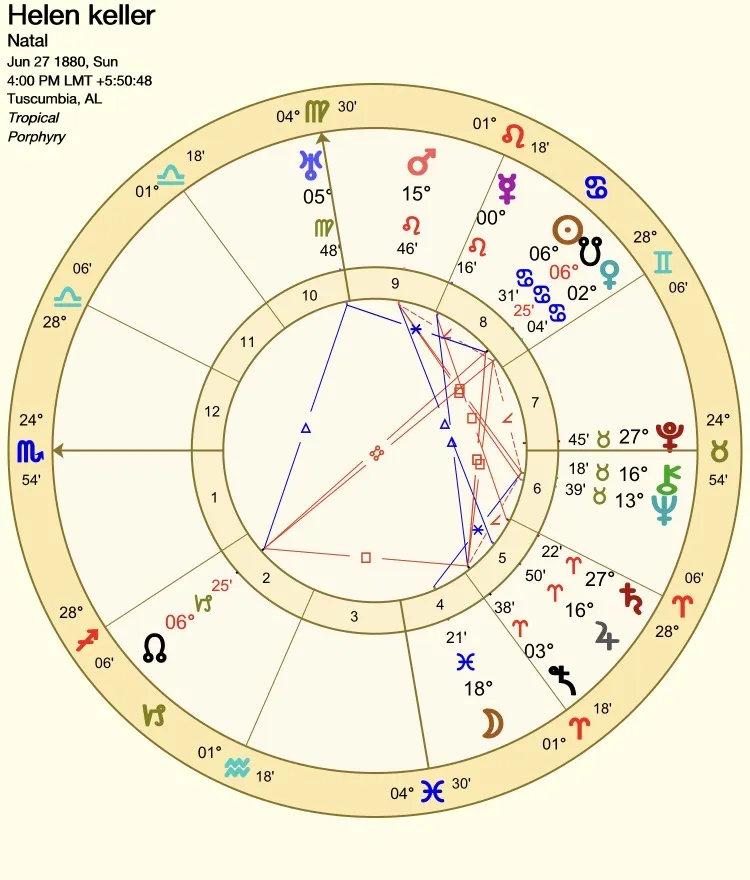
An examination of Helen Keller’s natal chart through Evolutionary Astrology shows why her convictions were so unyielding. Her chart reads less like a passive birth map and more like the blueprint for a spiritual tank.
At the base sits Pluto in Taurus in the seventh house, completely unaspected. An unaspected planet operates like an isolated power station. It has no buffer, no pressure release valve, and no easy way to diffuse its weight through other parts of the chart. Taurus governs the physical body, basic survival, and human worth. The seventh house forces those themes into the public square. Sitting alone, Keller’s Pluto forced her to confront her own survival from the start. Society viewed her physical body as broken and incomplete. Her Pluto mirrored her sensory isolation, forcing her to build an unshakeable foundation of self-worth from the earth up.
She took that fierce reclamation of her own dignity and turned it outward. Her South Node in Cancer in the eighth house, conjunct her Sun and Venus, brought a vast capacity for absorbing human suffering. Her ruling Moon in Pisces in the fourth house could have pulled her into a quiet retreat from the world.
Instead, her South Node held a sharp connection to Uranus in Virgo in her tenth house. Virgo does not deal in vague pity. It inspects the machine, identifies the broken gear, and demands a fix. Uranus forced her to translate deep empathy into rigorous public critique.
This dynamic showed up clearly in her fight against childhood blindness. Society viewed blindness as a mysterious act of God, a quiet cross to bear. Keller pulled at the statistical threads and uncovered a grim truth. A massive percentage of infants were born blind due to untreated venereal diseases, passed down because overworked parents had zero access to healthcare or clean living conditions.
Blindness was not a divine mystery. It was the direct result of industrial greed and widespread neglect.
Capitalism looked to her exactly like Swedenborg’s description of hell, a realm driven by self-interest and the urge to rule over others. She could not treat the physical symptom while ignoring the societal sickness. Her North Node in Capricorn demanded that she step into real public authority, guided by a disciplined Saturn and an expansive Jupiter joined in Aries. That placement gave her the courage to stand alone. Her activist fire found its engine in Mars in Leo, turning theology into a fighting force. Swedenborg provided the language, but her chart provided the mechanism.
When Keller wrote about inspirational triumph, the public applauded. When she spoke about class struggle and labor rights, the media turned on her. Editors who had praised her intellect suddenly claimed her physical disabilities made her easily manipulated by radicals. When the editor of the Brooklyn Eagle wrote that her political mistakes came from the limitations of her condition, Keller responded with cold clarity. She reminded him that his paper had praised her when she was a safe symbol, and pointed out that his own social blindness was far worse than her physical lack of sight.
She understood that society loves a miracle, right up until the miracle starts demanding a fair wage and an equal seat at the table.
A reverie inspired by Helen Keller’s chart: Fractured Realities
The Radical Lives of Helen Keller
Further Reading
- *My Religion* (also published as Light in My Darkness) by Helen Keller
- The World I Live In by Helen Keller
- *How I Became a Socialist* (1912 essay published in the New York Call)
- *Heaven and Hell* by Emanuel Swedenborg
- *Pluto: The Evolutionary Journey of the Soul (Vol. 1) by Jeffrey Wolf Green