Margaret Tudor’s Evolutionary Astrology: The Chart of a Tudor Queen
by catharine j anderson
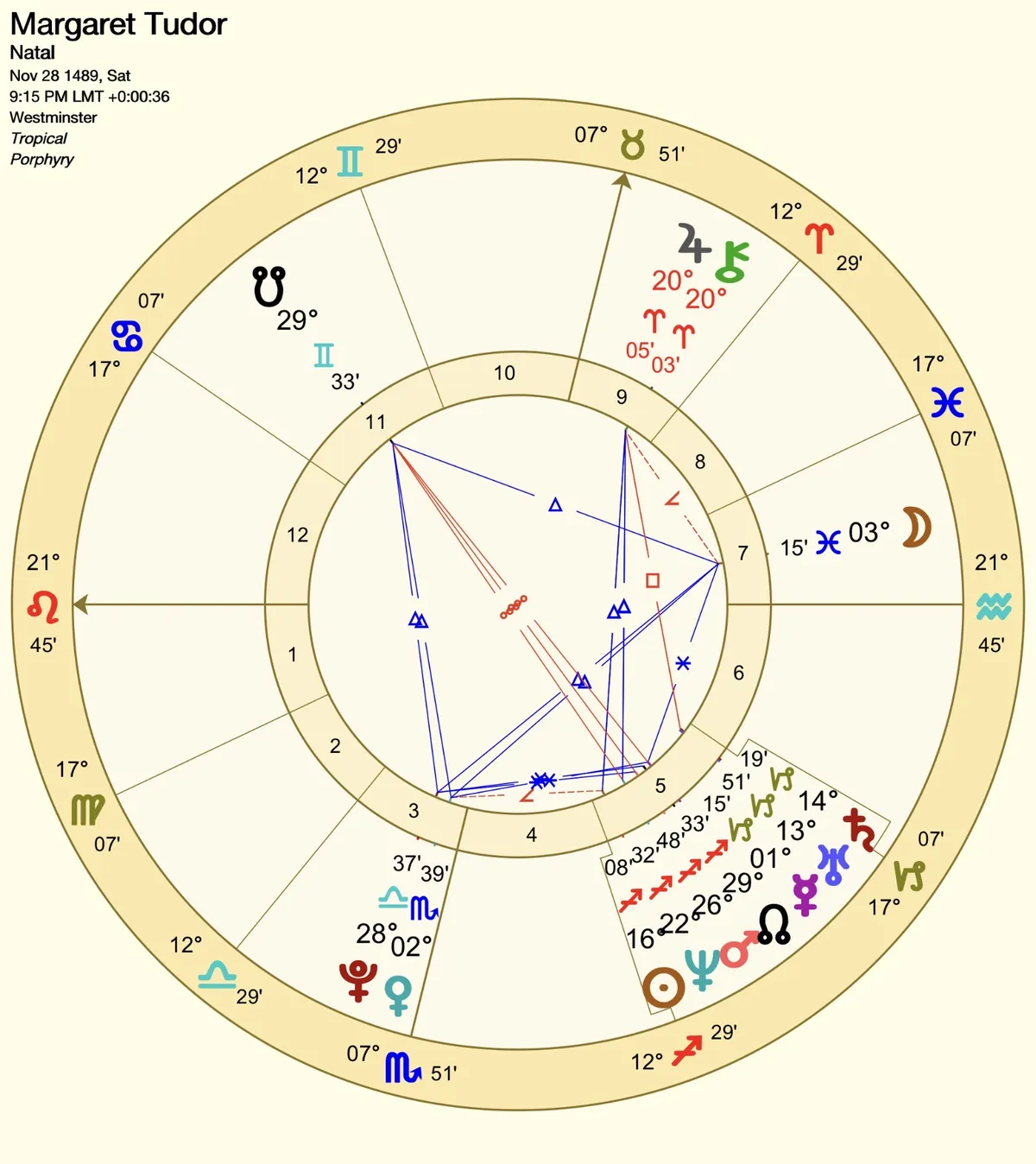
Pluto sits at 28° Libra in her third house. That is where you start. In Evolutionary Astrology, Pluto is the baseline. It is the soul’s past intentions and desires carried forward into the present life, as well as the soul’s deepest instincts.
For Margaret Tudor, Pluto in Libra in the third house meant lifetimes of high-stakes, paranoid diplomacy. It shows a soul conditioned to believe survival depends on secret letters, back-room deals, forced political marriages, and lying just enough to keep from getting killed. The third house correlates with local court gossip and border politics. Libra is the contract signed with a smile while holding a dagger behind your back.
Margaret came into this Tudor life wired to over-think, over-strategize, and trade her own truth for an uneasy political peace.
Her soul’s evolutionary exit door, Pluto’s Polarity Point, sat directly opposite at 28° Aries in her ninth house along with Jupiter and Chiron. This was her deepest existential wound: the wound of the sovereign self, a deep soul memory that says direct self-assertion causes catastrophe. Entwined with Chiron in the ninth house—the domain of foreign lands, higher laws, and religious dogma—her very existence was defined by exile and stolen autonomy. Sent to Scotland at thirteen to serve as a political pawn, she spent her life fighting for her birthright, only to have the Scottish lords weaponize the law to strip her of her Regency and custody of her sons. Every time she reached out to claim her independent will, institutional powers—from her brother Henry VIII to the Roman Curia—were waiting to crush her spirit.
Her soul was not asking her to be a clever double-agent anymore. The Aries ninth house demanded that she heal that Chiron wound by refusing to hide behind quiet diplomatic compromises. It wanted her to stop playing petty court politics and stand in her own sovereign conviction, no matter how many religious or political authorities tried to crush her.
She was born into a cold Tudor machine built on dynastic survival. Her father, Henry VII, was an administrative genius whose calculating energy mirrored her own Capricorn planets. He did not look at Margaret as a cherished child; he looked at her as a piece of political iron. In 1503, at just thirteen years old, she was shipped north into the Scottish cold to marry King James IV, used as an instrument to seal a peace treaty. He taught her early that personal desire was secondary to statecraft, instilling the hard Capricorn discipline she would need to survive. When she wept at leaving England, her court made it clear: Tudor women do not cry. They rule.
Her mother, Elizabeth of York, represented the lost softness of her chart—resonating with her Moon in Pisces in the seventh house. Elizabeth brought Plantagenet grace to a cold court, but she died in childbirth just months before Margaret was sent north. Losing her mother stripped Margaret of her primary emotional anchor right at the threshold of her ninth-house exile. She was thrust into a foreign land where her English blood was viewed with constant suspicion.
She brought all her past-life instincts with her, rooted in her South Node in Gemini in the 11th House. In Evolutionary Astrology, the Gemini 11th House South Node is the comfort zone of intellectual hedging, playing factions against each other, gathering court gossip, and relying on clever networking or political alliances to feel safe. It is the instinct to be a middleman, adapting a story to whoever is in the room to avoid taking an absolute stand.
Her North Node in Sagittarius in the 5th House was her ultimate evolutionary assignment, but it did not sit alone. Margaret carried a massive, powerhouse seven-point stellium in her 5th house—the domain of royalty, divine right, children, and personal legacy. Her soul sat split across two distinct engines of survival in that single house.
On one side was raw Sagittarian fire: her Sun, Mars, Neptune, and North Node clustered together, demanding she step out of the shadows, claim her royal conviction, and act with unapologetic Tudor pride. Neptune added a romantic, high-minded idealism to her royal identity, while Mars gave her the instinct to fight for her birthright.
Right beside that fire sat a cold wall of Capricorn steel: her Mercury, Saturn, and Uranus, all crammed into the same 5th house. Where her Sagittarius planets wanted to gallop forward on righteous conviction, her Capricorn planets forced her to pay the toll in brutal political reality, endurance, and strategic discipline.
At first, her Moon in Pisces in the seventh house got exactly what it wanted. A seventh-house Pisces Moon wants a romantic sanctuary. In James IV, she found a heroic canvas: a chivalrous, cultured king who treated her with courtly devotion. Her Pisces Moon formed a seamless, exact trine to her Venus in Scorpio, filling her youth with a deep, emotional idealism. She loved him.
Then her husband got his chest split open at the Battle of Flodden.
Dead in the dirt in 1513, alongside half the nobility of Scotland, because his own romantic chivalry pushed him into a disastrous invasion of England. The tragedy shattered her Pisces sanctuary in an instant. Overnight, she was twenty-three years old, holding her seventeen-month-old infant son, James V, in her arms. She was thrust from honored Queen Consort to Regent of a hostile realm, surrounded by anti-English lords who viewed her as a dangerous foreign threat.
In the wake of Flodden, her 5th house became her war zone. The Sagittarius side of her stellium—fueled by Neptune’s romantic ideals—desperately reached for a savior. Reacting out of her unhealed Aries Chiron wound, she sought an immediate protector so she wouldn't be crushed by the council. In August 1514, she fell for Archibald Douglas, 6th Earl of Angus, a handsome, physically daring opportunist. Her younger sister, Mary Tudor, would later make a similar scandalous marriage for love in the safety of the English court. But Margaret was in Scotland.
Her 5th house was also ruled by the heavy hand of Capricorn. Sitting at 14° Capricorn, her exact Saturn-Uranus conjunction acted like a loaded landmine embedded in her royal legacy. Every time her Sagittarian impulse made a bold, idealistic leap, her Capricorn Saturn enforced the rigid law of dynastic duty, while Uranus detonated her structures overnight. Because both forces lived in her 5th house of children, the explosion hit where it hurt most. Under Scottish law, the terms of James IV’s will stated that Margaret could only remain Regent as long as she stayed unmarried. The moment her marriage to Angus was exposed, the Scottish council acted with cold authority. They stripped her of the regency, used ninth-house legalities to invalidate her power, and appointed the French-born Duke of Albany in her place.
When Margaret refused to yield, Stirling Castle was placed under siege. They ripped her children out of her arms—her fifth-house legacy stolen in a single afternoon. She was forced to flee across the border in disguise, riding a skinny horse through the mud, broke and destitute, giving birth to her daughter in a freezing border castle while stripped of her jewels and income.
Angus turned out to be a parasitic traitor. He stole her revenues, cheated on her openly, and eventually seized physical control of her teenage son, holding the young King James V hostage to rule Scotland through fear.
Her younger brother, Henry VIII, only deepened her pain. Henry was a Cancer Sun—protective, moralistic, and obsessed with his own dynastic authority. Margaret was a Sagittarius Sun, built for freedom and direct truth. Their Suns sat in a friction-filled quincunx. Henry treated Margaret like a pawn, demanding she obey his orders from London and using her for border intelligence, while abandoning her whenever it was convenient.
When Margaret began fighting for a divorce from Angus in the 1520s, Henry sent sanctimonious, furious letters invoking Christian morality to lecture her, accusing her of damning her soul. It was an incredible display of sibling hypocrisy: just a few years later, Henry would break England away from Rome entirely to secure his own divorce from Catherine of Aragon. Margaret called out his double standards openly, using her sharp Capricorn Mercury at 1° to point out that her annulment was legally clean, while his was tearing Western Christendom apart.
Margaret did not break because she finally learned how to drive both halves of her 5th house. She stopped letting raw Sagittarian fire make impulsive choices, and she stopped letting her 11th-house South Node hide behind treacherous allies. She stopped looking for men to rescue her. Instead, she synthesized her chart.
She harnessed her fiery Sagittarius Mars and North Node to claim the bold, unyielding conviction of her birthright, and paired it with the cold, calculating precision of her 1° Capricorn Mercury. Anchored by that stone-cold Mercury, she used her exact Moon-Venus water trine supported by Pluto's deep instinct, using that emotional acuity as a razor-sharp tool to read human nature, sense power dynamics, and out-think her enemies.
She executed a brilliant coup in 1524, declaring her twelve-year-old son of age to rule and seizing power back from Albany. When Angus trapped her son again, she didn't sit in a corner and weep. She claimed her Aries Pluto Polarity Point alongside her 5th House Sagittarius North Node, turning her Chiron wound into an unshakeable source of personal authority. The 5th house that had been the site of her greatest losses became the exact crucible where she forged her royal legacy.
In an act of raw, direct self-determination that shocked all of Western Europe, she hounded the Vatican, mastered ninth-house legal channels herself, and forced through a formal annulment from Angus in 1527. She wrote letters that were impeccably polite on top and carried sharp steel underneath. She defied her terrifying brother Henry openly, refusing to let him turn Scotland into an English puppet state. By 1528, her son escaped Angus's clutches in disguise, reunited with Margaret, and assumed full personal rule of Scotland.
When she died at Methven Castle in October 1541, she had mastered the lesson of her chart. She had taken her Chiron wound—the deep pain of exile, thwarted authority, and foreign isolation—and transformed it into an unyielding, quiet self-reliance. She took the raw, volatile fire of her soul, ran it through the cold Capricorn furnace, and learned how to stand upright in the mud without ever losing her footing.
Henry VIII went to extraordinary, bloody lengths to secure a male heir, executing wives and breaking churches, yet his children left no lasting bloodline—Edward VI died young, Mary I childless, and Elizabeth I childless.
It was Margaret’s bloodline that won the war. Through her son James V and her granddaughter Mary, Queen of Scots, her great-grandson James VI of Scotland rode south six decades later to be crowned James I of England, unifying two historic enemies under a single crown. The girl sent north as a thirteen-year-old political pawn had become the quiet, strategic root of an empire—proving that true power is not given by a king or written on a treaty, but forged in the enduring wisdom of a soul that learns how to survive the storm.
Recommended Reading
The Fifth House in Evolutionary Astrology: Evolution of the Creative Ego
Sir Thomas More’s Soul Journey: An Evolutionary Astrology Birth Chart Analysis
Anne Boleyn and Anne Frank Reincarnation: An Evolutionary Astrology Analysis
Pluto: The Evolutionary Journey of the Soul (Volume 1) by Jeffrey Wolf Green