The Seed of the Revolution: Rubber Soul, Uranus, and the Evolution of Rock
by catharine j anderson
Up until October 1965, pop music adhered to a rigid, commercially safe construct. You had one or two guitars, a bass, and drums. Songs stayed under three minutes. Albums contained two hits tailored for AM radio, mostly about falling in love, while the rest of the vinyl was padded with covers and cheap filler. Saturn assured that everything stayed predictable. Underneath that sanitized structure, though, the collective was getting restless, starved for real weight and authenticity.
On October 9, 1965, at 3:17 P.M. EST (20:17 GMT), Uranus and Pluto made their exact alignment at 18 degrees of Virgo. In Evolutionary Astrology, that conjunction acts as a detonator. Pluto pulls up the subterranean pressure of the collective soul while Uranus shatters the mold. Grounded in Virgo, that energy did not just dream about a new order—it demanded precision, sweat, and hard work to build it.
Less than three days later, the door to Studio Two at EMI Studios opened. At 2:30 P.M. BST on Tuesday, October 12, John, Paul, George, and Ringo set to work recording Rubber Soul.
The record company wanted an album in time for Christmas. In four short weeks, it was done. Released in the UK on December 3rd, it blew up the standard pop formula.
Rubber Soul ditched filler material completely and refused to anchor the UK release with a lead single. The Beatles treated the LP as a single, cohesive piece of art. Even the cover art broke the rules: a distorted photo without the band's name printed on the front, letting the mood carry the weight.
Musically and lyrically, the record dragged pop out of its adolescent comfort zone. Simple boy-meets-girl songs vanished, replaced by raw jealousy, existential self-doubt, and quiet vulnerability in songs like "Norwegian Wood," "Nowhere Man," and "In My Life." They introduced fuzz-tone bass, exotic percussion, speed-altered piano solos, and George Harrison’s sitar. They proved a rock album could carry real psychological grit, forcing the entire industry to raise its standards and setting off a chain reaction across the globe.
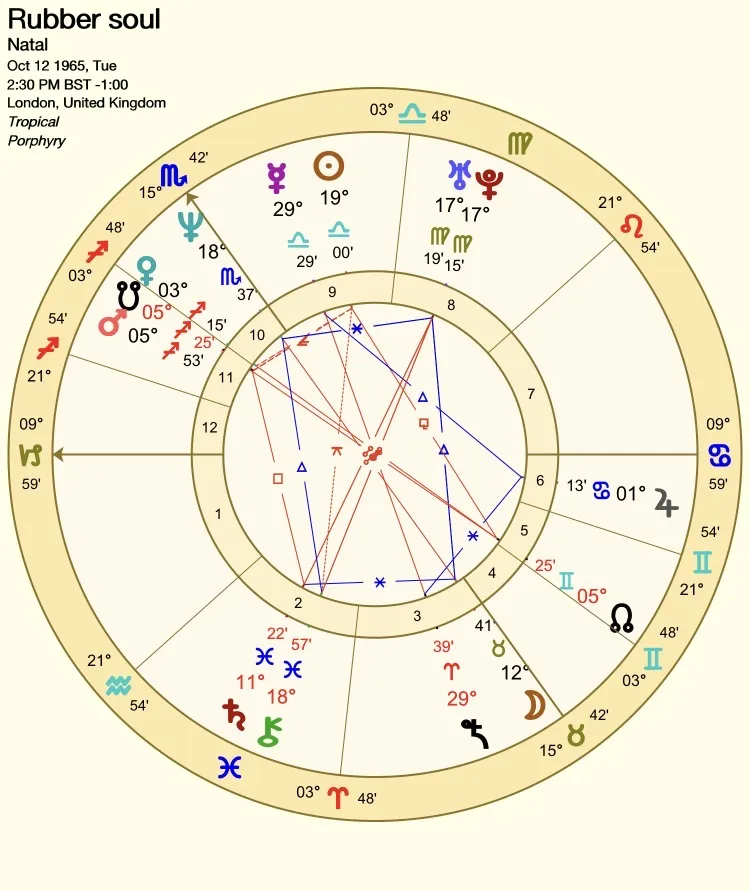
Calculated for the moment The Beatles started recording, the chart maps this radical shift. Sitting in the eighth house, that Uranus-Pluto conjunction dragged up hidden shadow, vulnerability, and obsession. Directly across the sky, Saturn in Pisces stood guard in the second house, clinging to dying values, rigid constructs, and sanitized formulas. That opposition was a massive cultural friction point.
A grounding trine to the moon in Taurus in the third house gave all that psychological weight a physical, earthy voice, turning inner angst into tangible sound. In the tenth house, Neptune in Scorpio cast a subtle sextile back to the conjunction, opening public consciousness to a deeper, mystical hunger.
The nodal axis laid out the road ahead. The south node sat conjunct Mars in Sagittarius in the first house. This was the old comfort zone of bold stage energy, simple anthems, and outgoing showmanship. But with its ruler, Jupiter, sitting in the sixth house of daily discipline, that outward show had run its course. It was time to pull back and do the quiet, painstaking work in the dark.
The north node in Gemini in the fifth house demanded fresh experimentation, curiosity, and lyrical agility. Its ruler, Mercury in Libra in the ninth, called for elevated dialogue, artistic partnership, and ideas built to expand minds. Venus hid away in the twelfth house, drawing raw inspiration directly from the vast ocean of the collective unconscious and pouring it straight onto tape.
Breakthroughs spread like wildfire. Out in California, Brian Wilson dropped the needle on the US Capitol Records pressing. Capitol had altered the track list to fit the American folk-rock trend, stripping away R&B-leaning tracks like "Drive My Car" and opening instead with the gentle, acoustic "I've Just Seen a Face". Unintentionally, Capitol created an extraordinarily fluid, acoustic-driven album experience. Hearing it, Wilson realized a pop record could be a seamless, thematic piece of art. He answered with Pet Sounds. The Beatles heard Pet Sounds and pushed right back into the studio to craft the strange, layered worlds of Revolver and Sgt. Pepper’s. At the same time, players like Jimi Hendrix and Jeff Beck started gouging their amps with feedback, turning the electric guitar into something primitive. Rubber Soul gave rock its brain. The street was about to give it a fist.
The mid-sixties were about expanding your mind, but 1968 slammed that expansion straight into the concrete. The draft, the escalation in Vietnam, blood in the streets, and political assassinations tore the utopian dream to shreds. When Uranus moved into Libra in October 1968, it exposed every crack in the culture. Virgo had provided the meticulous, obsession-driven studio work to build the new vehicle. Libra brought the violent demand to confront social conflict, injustice, and broken systems. The mind that woke up three years earlier now had to process a world on fire. Pop music dropped its nice act. The Beatles slammed out the brutal wall of noise on "Helter Skelter." The Stones gave us "Street Fighting Man," which matched the heat in the streets. Led Zeppelin plugged in, turning blues roots into pure, heavy thunder.
You can trace that line all the way through the Uranus-in-Libra years. everything from the dark, soaring noise of Pink Floyd to the heavy sludge of Black Sabbath and the glam, fluid armor of David Bowie. It was a culture wrestling with its own ghost. Rubber Soul was the seed dropped in the dirt back in October 1965. It ripped up the unwritten contract between record executives and kids buying 45s, proving a record could carry the full weight of where we were heading.
It's proof that culture doesn't move by chance. When the collective floor drops out, the artists with the sharpest instincts are the first ones to fall through it and start planting seeds.
- Sunshine and Shadows: Brian Wilson
- Symmetrical Violence: Jimi Hendrix and Uranus in Libra
- David Bowie’s Ziggy Stardust: An Evolutionary Astrology Study
- Missionaries of Noise: Black Flag, Damaged, and the Ignition of Uranus in Sagittarius
- Todd Rundgren Initiation Album Review: 1975's Experimental Masterpiece
References
- Michelsen, Neil F. The American Ephemeris for the 20th Century (1900–2000 at Midnight). ACS Publications.
- Green, Jeffrey Wolf. Pluto: The Evolutionary Journey of the Soul (Volume 1). Llewellyn Publications.
- Lewisohn, Mark. The Complete Beatles Recording Sessions: The Official Story of the Abbey Road Years 1962–1970. Hamlyn / EMI.
- Kurlansky, Mark. 1968: The Year That Rocked the World. Random House.